Recently, there has been a worrying rise in job offer scams in Denmark to people who live outside of Denmark. These fake job offers often come with tempting promises, like high pay, help getting a work permit, or an easy placement. But behind the facade are job scams. CareerDenmark is here to explain to people how to be aware of job fraud before they fall for it.
Scammers are always coming up with new ways to trick people. These job scammer situations thrive in a world where globalisation, remote recruiting, and the number of people looking for jobs abroad are all on the rise. This is especially true for people from countries that are less familiar with Danish laws. It’s important to know how to protect yourself and spot fake job offers.

- What Makes a Job Offer Fake?
- Signs of Job Offer Scams
- Why It Happens to People Looking for Job Offers in Denmark
- How to Keep Yourself Safe: Proven Steps to Take
What Makes a Job Offer Fake?
Even though each job offer scam may have its own twist, there are some things that are always the same. Many come as “work-from-abroad” offers or promise to take care of the paperwork needed to get a job and work permit in Denmark. The risk is that you will be asked to pay fees up front, which can be a lot of money, or to give out private or banking information. After the payment is made, the “recruiter” disappears. This model is similar to what is known as an advance-fee scam. A job scammer promises something (like a job, a permit, or a life abroad) and then asks for payment up front, but the promise never comes true.
According to the Ministry of Foreign Affairs of Denmark, Job offer scams are set up by private individuals, usually on social media, who make fake job offers to professionals aspiring for an international career. By pretending to function as recruitment agents for Danish companies, such individuals deceive professionals into believing that they have been offered a job in Denmark. For their services, the fake recruitment agents often charge a considerable amount of money.
People looking for jobs in other countries often get contacted out of the blue (even if they didn’t apply), get a great job offer, and then have to pay for services like visa processing, work permit processing, and recruitment fees. Legitimate Danish employers or registered recruitment agencies do not ask candidates to pay for job offers.
Job scammer may pretend to be from a real company, even using the company’s real name or saying they are connected to Danish companies. This makes it harder to check, but it doesn’t make it real.

Signs of Job Offer Scams
You never sent in a CV, but get job offers out of the blue, be wary.
- Upfront payment requested for a work permit, agency fee, visa handling, “guaranteed placement or other services. The official website for information about the application process is the website of the Embassy of Denmark in the country you are living in, and on the website New In Denmark via The Danish Agency for International Recruitment and Integration (SIRI). Here you can find full instructions on how to apply for a work permit, including information about fees. The decision to grant or refuse an application is taken by the Danish Immigration Service in Denmark.
- Fraudulent job openings request for sensitive data or bank details early. Legitimate hiring only asks for banking or tax info after formal hiring; asking for bank account numbers, identity verification, or payment early is a big red flag.
- Generic or personal email domains instead of corporate ones. Job scammers often use free webmail services (like Gmail or Yahoo) or strange domains instead of the company’s official domain name.
- Vague job descriptions, unrealistic pay or benefits, “easy” employment. Fake job offers promise good pay for little work, few or no relevant qualifications, or promise to guarantee a work permit/visa are suspicious.
- Pressure to act quickly or a limited-time offer. Job fraud happens when scammers often use urgency to stop you from checking out the company or thinking things through.
No proof that the company exists or is registered. Many real businesses in Denmark are listed in public registries like the national business registry (e.g., CVR registry), but companies with fake job offer often not found there. You can use Virk to check VCR registry information about Danish companies.
Job Fraud Complaints
One person on a forum about job offers in Copenhagen said this about a suspicious offer:
“I just looked them up on CVR, which is where all Danish companies have to register, and nothing comes up.”
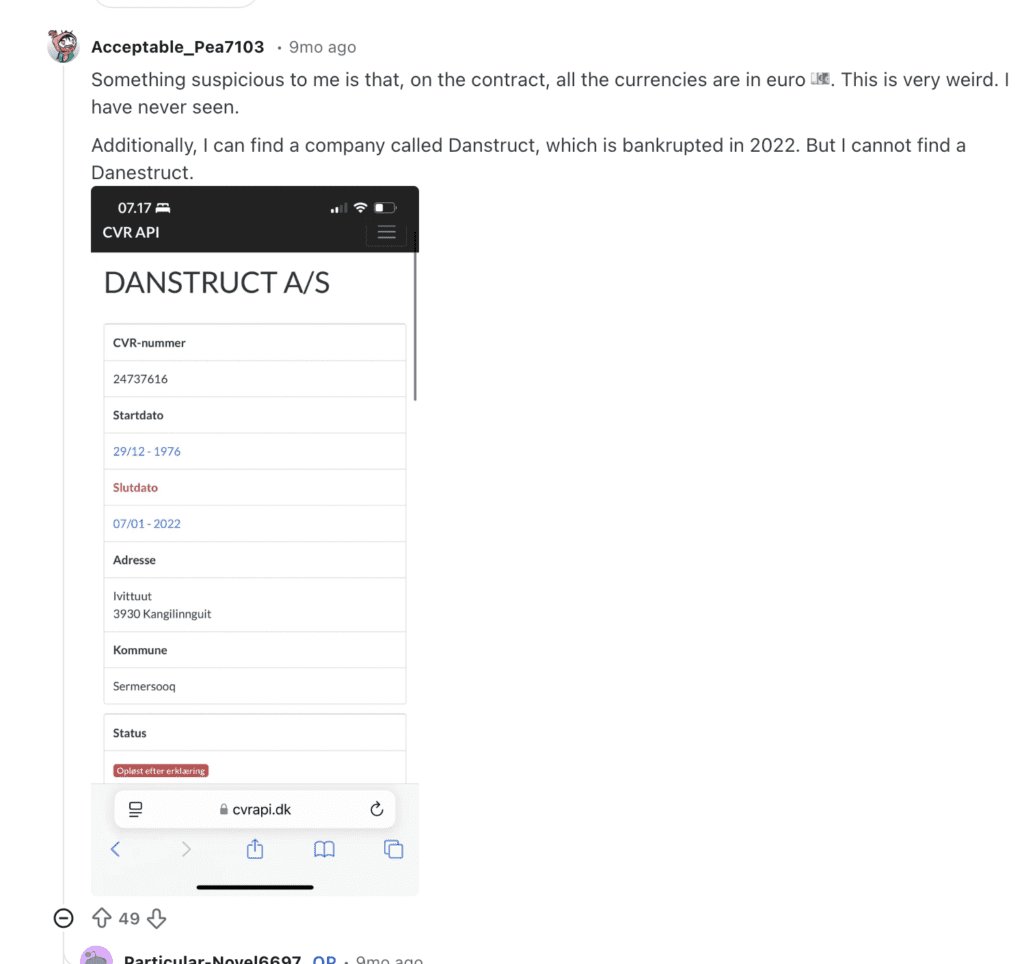
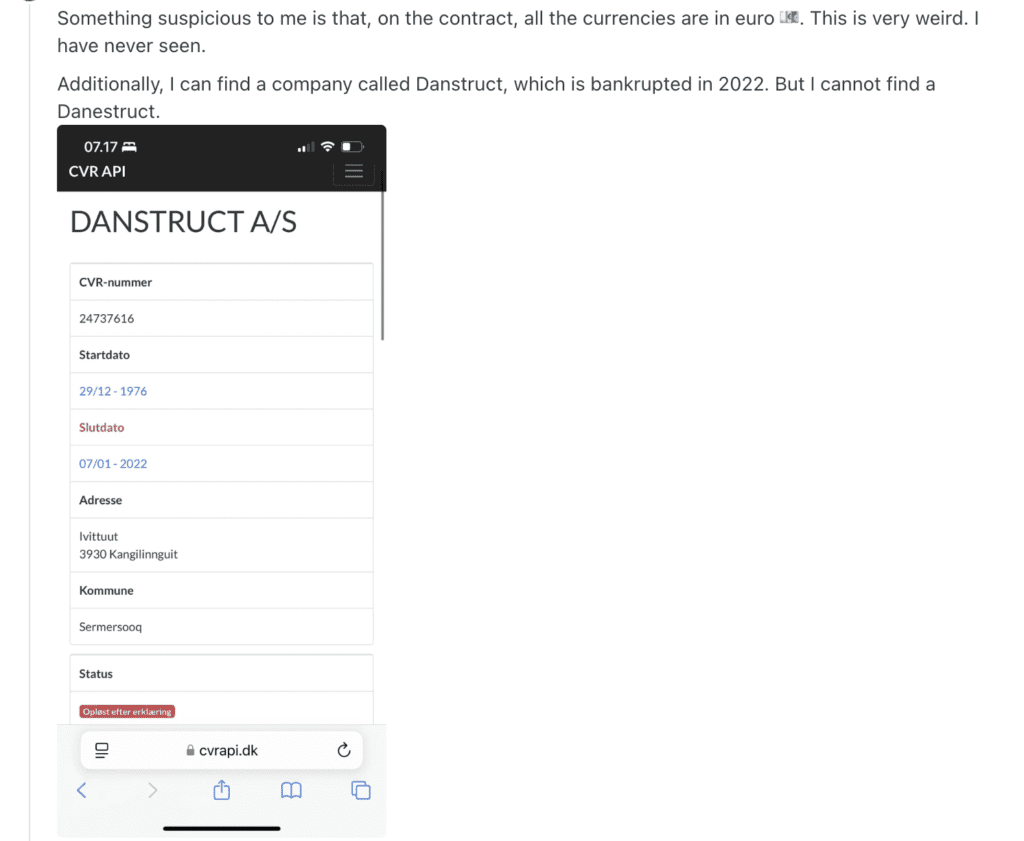
Other users called the whole offer a scam because of this kind of anecdotal evidence, the lack of a CVR listing, the unrealistic pay in euros, and the fact that the company might not even exist.
Why It Happens to People Looking for Job Offers in Denmark
There are a number of reasons why fake job offers for Denmark are becoming more and more common:
- High demand for international workers, Denmark, like many other countries, gets a lot of job seekers from other countries looking for better pay and living conditions. This pool gets people ready to trust job fraud that promises help with getting a work permit or moving.
- Difficult rules and processes that aren’t well-known. People who live outside of Denmark may find it hard to understand how to get a work permit, a visa, a residence permit, pay taxes, or register as an employer. People who don’t know this are taken advantage of by job scammers who offer “help” and then charge for it.
- Globalisation and online reach. Job scams that are misleading can reach people all over the world because both recruiters and scammers work online, even across borders. Scammers can still reach job seekers who are far away by pretending to be from Danish companies or agencies.
- Vulnerability for those in urgent need. People looking for work often feel a sense of urgency because they need a steady income, want to move, or feel pressure to get a job quickly. People may skip verification and fall for scams when they are under that much stress.
How to Keep Yourself Safe: Proven Steps to Take
Being careful, checking things out, and being skeptical are the first steps to avoiding job scams. This is a useful checklist based on the advice of CareerDenmark and general rules from European and global anti-fraud organisations.
Check the company’s registration. Most legal businesses in Denmark are registered, for example, in the national business registry, which is often called CVR. If you can’t find any information about the company that offered you a job, be wary of the offer.
Check official communication. Real job offers, and agencies will usually use their own domain (for example, `name@company.dk`) instead of free email services like Gmail or Yahoo.
Look up the company online. A real business will have a website with contact information, news articles, references, or reviews. Not having an online presence, or only having a small one, is a warning sign.
Don’t pay any fees or deposits up front for a job offer. If someone asks you to pay for recruitment, work-permit processing, visa support, or training, it’s a scam. Employers who are real pay you, not the other way around.
Don’t give out private information too soon. You should only give out your bank account number, identity number, credit card information, or other personal information after you have confirmed that the employer is real and, even better, after you have signed a real contract.
Expect a proper interview or application process. Real employers usually interview candidates (in person, via video, or at least by phone), not just send “Congratulations — you’re hired!” right away. Be careful if you get an offer without a real interview or after a very short process.
Don’t rush, take your time. Job scammers like to make you feel like you need to act quickly. Real employers know that you shouldn’t make decisions about jobs right away.
Stick to official job boards, well-known agencies, or company websites. Stay away from shady ads on random social media groups, message-based job boards, or unsolicited offers through WhatsApp, Telegram, or other apps.
You can check current open positions by visiting our job seekers page. There are also a bunch of pages where you can check jobs within your field:
If you can, get in touch with the company directly. Call them on a verified landline, ask to speak with HR, and confirm the offer with them. If they don’t want to talk to you in person or only talk to you through chat or instant messages, that’s a bad sign.
Note: Career Denmark is not a requirement agency – our approach is different. We create a base for you to find your dream job in Denmark
Last thoughts: The Best Way to Protect Yourself From Job Offer Scams
People from other countries looking for work may find the idea of a good job in a well-run, wealthy country like Denmark very appealing. But CareerDenmark’s warning shows that that promise can become a trap if you don’t carefully look over the job offer scams you get.
Always remember that real employers want to hire good workers, so they don’t need to charge you a fee or ask for your personal banking information. If someone asks you to pay “to get a job,” it’s not a job; it’s a job fraud.
If you put due diligence, independent verification, and caution first, you won’t fall for fake job offers. Don’t skip basic checks just because you’re desperate or excited. Don’t rush. Do your schoolwork. And if you’re not sure, just walk away.
We can help make sure that Denmark stays a place of real opportunity, not exploitation, by sharing these rules widely with friends, communities, and international job boards.
The holder of registered phone numbers in Denmark can be looked up online, e.g. at www.krak.dk. Note that also false companies can have registered numbers. In order to validate the existence of the company in question, you can look up the company in the Danish state’s “Central Business Register,” where all Danish companies are registered. Keep in mind that the offer might refer to a genuine company, but still be fraudulent.
Join our community for daily tips and updates on Instagram, LinkedIn, Facebook, and TikTok.